At 4 am, Chrissy Mpata of Sawayeka on the nothrern margins of Mzuzu City leaves her husband fast asleep and disappears into the dark, carrying her bucket.
Her third-born daughter follows half-asleep, down a hill dotted with emerging houses.
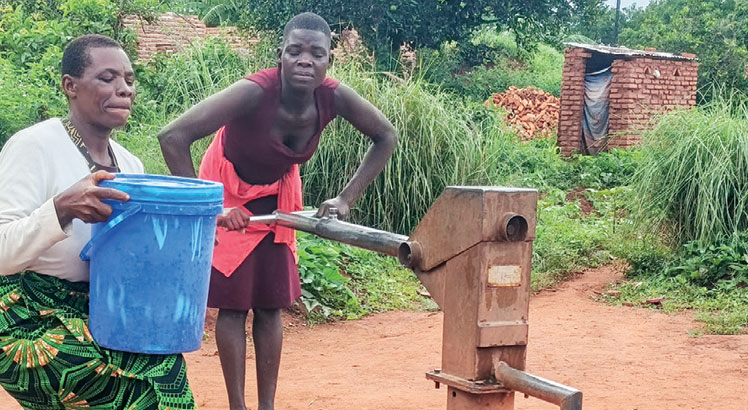
At Kamunkhota, about a kilometre away, a borehole near Nkhorongo Community Day Secondary School serves four peri-urban settlements.
On arrival, Mpata, 49, joins the queue, placing her bucket in a crooked line as the pump rises and falls.
“I often make two trips before sunrise to replenish water for drinking and cooking. For bathing and washing clothes, I go to a nearby stream,” she says.
By the time the couple leaves for farmwork and piecework, the water is gone and she has to refill the buckets in the afternoon.
Common awakening
Thousands of Mzuzu residents begin their day the same way as the city has fast outgrown its water supply system.
For two decades, settlements have scaled surrounding hills and valleys, but water pipes are stuck in the city where tapsfrequently dry up.
Many households in emerging peri-urban settlements like Sawayekha, Masasa, Lusangazi and Sonda rely on boreholes when government policy has shifted towards piped water.
At Mzuzu University, Precious Namaona and 15 other students share a tap that runs dry two to three times a week—compelling them to buy water from neighbours with storage tanks.
“A 10-litre bucket costs K200, so we’ve to use it wisely: One pail for bathing, another for cooking and washing dishes. Sometimes, we stop bathing. This makes life unbearable,” he says.
Northern Region Water Board (NRWB) spokesperson Edward Nyirenda says intermittent water supply in Luwinga and Lupaso, where most students live, is caused by population pressure on an aging system prone to pipe bursts.
According to Nyirenda, the rusty pipes were designed to meet demand forecast around 2005.
However, the population of Mzuzu has surged from about 200 000 to 285 000 ever since.
“The city’s main water source, Lunyangwa Dam, feeds a treatment system that produces about 20 million litres of water a day against a daily demand of around 30 million litres,” he says.
The shortfall of about 10 million litres leaves thousands with unmet demand for safe water—notwithstanding leakages, illegal connections and faulty meters that drain 30 percent of treated water, according to Nyirenda.
Meanwhile, low-income earners pushed out of the city and rural dwellers looking for greener pastures increasingly settle in hills, swamps and other tricky terrains without access to potable water, hoping roads, power lines and water pipes would follow later
The areas include Lusangazi, Masasa, Sonda, Salisbury Lines, Dunduzu and Nkhorongo Hills.
But Mzuzu City Council spokesperson McDonald Gondwe has bad news for unplanned settlements emerging without protected service corridors.
“Once houses are built, introducing roads or water pipelines becomes difficult and costly,” he says.
The council plans to regularise the settlements in Nkhorongo, Lusangazi and Sonda, but locals say implementation is too slow.
Mercy Mwanza, 62, lives near Kamunkhota borehole where tempers flare before daybreak amid fierce scrambles for water.
Nkhorongo-Lupaso Ward councillor James Marshall Mhlanga says piped water reaches about 30 percent of his community.
“In communities between Area 1B and Lupaso, pipes pass underneath, but the taps remain dry. In 2017, Plan Malawi recommended storage tanks to raise water pressure for hilly settlements such as Sawayeka, but residents still use the same old borehole,” he narrates.
Supplying peri-urban communities requires more than just extending pipes, Nyirenda states.
“The entire supply chain must expand: Raw water intake, treatment capacity, storage and transmission pipelines,” he says.
NRWB’s €47 million (about K94.9 billion) Water and Sanitation Services Improvement Project, funded by the European Investment Bank, includes pipeline rehabilitation, booster station upgrades and solar power installations to reduce pumping costs.
However, the investment still falls short of the city’s fast-expanding demand as the 2026/27 National Budget, under scrutiny in Parliament, gives irrigation a lion’s share of public spending for water.
$600 million question
Water, sanitation and hygiene (Wash) activist Willies Chanozga Mwandira says Malawi requires $600 million (about K7.05 trillion) to close existing service gaps and meet Sustainable Development Goal Six: safe water for all by 2030.
“Mzuzu require large-scale infrastructure programmes like the Salima-Lilongwe water project to overcome persistent water shortage,” he says.
The first Malawi 2063 Implementation Plan—the country’s springboard to achieve SDGs—promises safely managed water systems for growing cities to achieve SDG6 and combat diseases outbreaks caused by contaminated water.
The National Water Policy calls for a shift from boreholes to treated piped water for all, even rural supply.
For a city expanding faster than water pipes, the policy shift remains sheer rhetoric.